
Free-Threading Python vs Multiprocessing: Overhead, Memory, and the Shared-Set Meltdown

Last time in Python Threads: GIL vs Free-Threading, we did the classic Python party trick:
Same code
Same machine
Two realities:
Standard CPython (GIL on) → threads behave like a single checkout lane
Free‑threading build (GIL off) → threads can actually run in parallel
That post answered a very specific question: “Do threads finally do real CPU parallelism in Python?”
Answer: yes, in the free‑threading build. And the OS agrees.
Now comes the annoying follow‑up that matters in real systems:
Cool. But should I use free‑threading threads… or just stick with processes like we’ve all been doing for 15 years?
This new series is about that tradeoff — not as ideology (”threads good / processes bad”), but as boring physics: time, memory, and overhead.
Why I’m writing this
The old Python concurrency rulebook was simple:
Threads are for I/O
Processes are for CPU
If you want speed, push the hot loop into Fortran/C/C++/Rust
That rulebook existed because the GIL made CPU‑bound threads mostly a scheduling cosplay.
Free‑threading changes that. It doesn’t make Python bytecode faster per instruction — it makes threads stop taking turns behind one global lock.
Which means:
Threads are no longer automatically “fake CPU parallelism”
But processes still give you things threads never will: isolation, separate heaps, separate crashes, separate GILs, etc.
So the question isn’t “which is better?”
It’s:
What’s the tax you pay to get parallelism?
And when does that tax matter more than your algorithm?
Scenario 1 is the “before you even talk about your workload” benchmark.
TL;DR punchline
Threads: low control‑plane cost, tight memory footprint.
Processes: fine for chunky work; brutal for tiny work on spawn-heavy platforms.
Shared state: can erase your parallelism no matter what you pick.
Methodology
Python builds
Machine A (Ubuntu 25.10 and Windows 11 Pro):
CPU: AMD Ryzen 9 9950X 16-Core Processor
RAM: Corsair CMT64GX5M2B6000Z30 2x32GiB DDR5 6000 MT/s
Machine B (macOS): Apple M3 Max
Threads use the free‑threading build and processes use the GIL build. This is a pragmatic comparison: threads only get interesting on free‑threading, while most people still run processes on stock CPython. It does mean interpreter-build differences are in the mix, and free‑threading can shift allocator/GC/lock behavior. If you want a pure build-to-build control, re-run processes under the free‑threading build on the same OS to measure that delta explicitly.
Scenario 1: “What’s the tax of choosing threads vs processes?”
This scenario measures two system‑level costs:
Control‑plane cost: how expensive it is to create / start / join / tear down workers
Footprint cost: how much memory those workers consume while alive
It’s deliberately boring. That’s the point.
If your real system does lots of tiny jobs, boring overhead becomes the main character.
The benchmark in one paragraph
Each iteration does:
Create N workers (N=8 here)
Run a tiny CPU function
Join workers
Repeat
There are two profiles:
Profile: overhead
Workers do one tiny CPU task and immediately exit
Run 1000 iterations
Goal: isolate startup + teardown overhead
Pool warning: this is the worst‑case for processes. A long‑lived pool pays most of this cost once (warmup), then per‑task overhead shifts to dispatch + IPC/serialization. On Windows (and on macOS by default), pool workers are still created via
spawn. If your design keeps recreating pools or launching short‑lived processes per job (serverless‑ish, CLI fanout, test runners), then yes, this is your life. Thread pools exist too, but thread create cost is usually low enough that reuse matters less.
How to run the benchmark
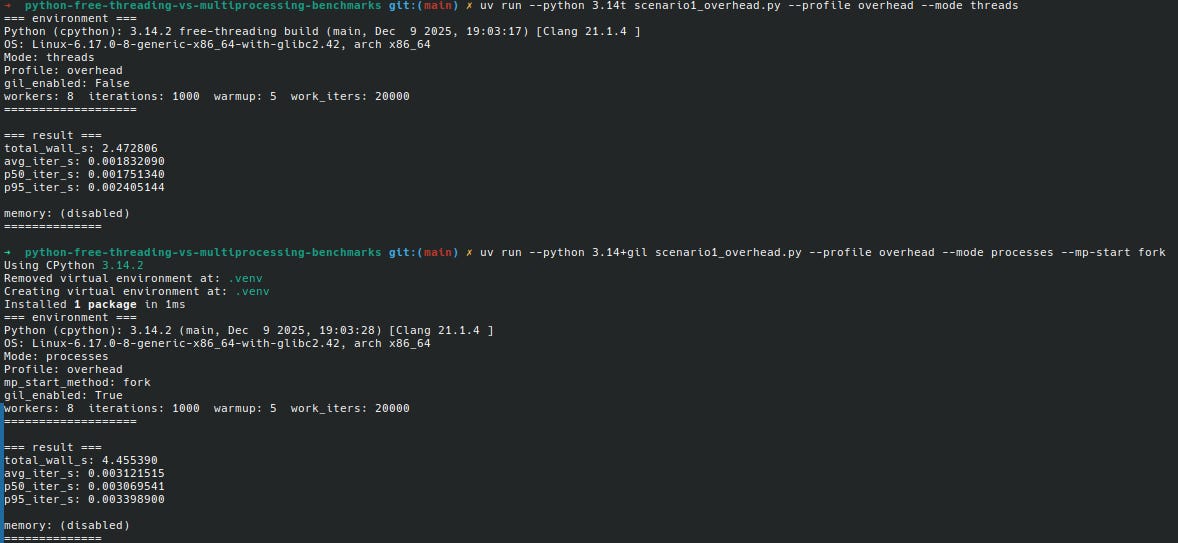
Profile: memory
Workers stay alive for hold_ms = 1000ms doing CPU work
Sample memory repeatedly using
psutil.memory_full_info():RSS (resident)
USS (unique/private)
PSS (shared pages split fairly; Linux-only)
Memory stats are summed across the parent and all worker processes
Goal: measure memory footprint under sustained load
Note: RSS/USS/PSS availability varies by OS, and frequent PSS sampling (especially on Linux) introduces significant overhead. Treat this profile as a footprint probe, not a timing benchmark.
How to run the benchmark
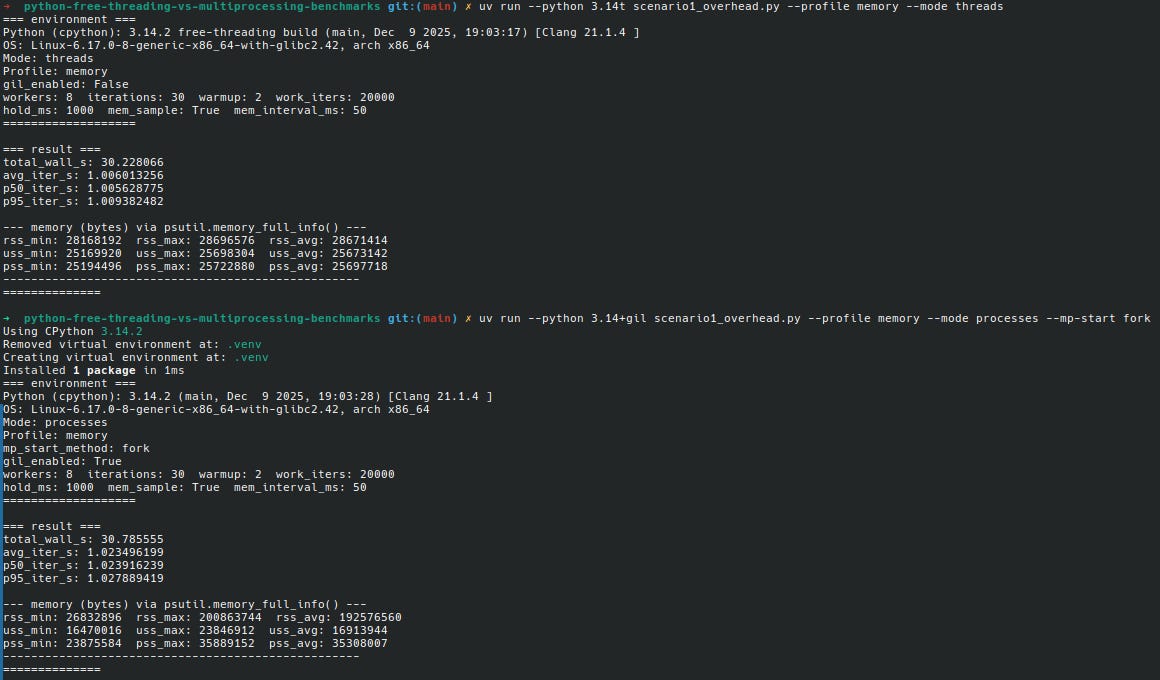
Scenario 1 results (Ubuntu 25.10 + Windows 11 Pro + Apple M3 Max)
Same knobs everywhere:
workers = 8
overhead: 1000 iterations
memory: 30 iterations, hold_ms = 1000, sample every 50ms
Ubuntu 25.10 (Linux 6.17, x86_64)
Overhead profile (avg time per iteration)
Linux takeaway: you get the full menu (fork, forkserver, spawn). For tiny jobs, fork wins, forkserver is okay, and spawn is the “boot a fresh interpreter” tax. It’s the safest and most portable method… and also the one that makes tiny tasks feel like trying to start Kubernetes for every HTTP request. On Linux/macOS, fork benefits from copy‑on‑write;
Crucial Note on fork:
fork()‘ing a multithreaded process is unsafe and could lead to deadlocks: the child inherits the locked state but not the threads that would unlock it, even invisible background threads from libraries make this unsafe. (See CPython issue: python/cpython#84559)
Memory profile (avg during the 1s hold)
Linux gives you PSS, which is the best available approximation for multi-process memory on Linux.
Read that like this:
RSS looks massive for processes because it double-counts shared pages.
With
fork, most memory stays copy‑on‑write shared, so summed USS can be surprisingly small (pages become shared and stop counting as “unique”); on Linux, PSS is the best footprint proxy.With
spawn, each worker has its own interpreter heap, so USS/PSS rise sharply.CoW sharing is workload‑dependent: once workers start writing into shared pages (allocator arenas, refcounts), those pages get copied and the
forkadvantage shrinks.
Windows 11 Pro (25H2, AMD64)
Overhead profile (avg time per iteration)
Windows is effectively spawn-only, and you can see it in the bill (it calls CreateProcess, which is a heavyweight operation)
Memory profile (avg during the 1s hold)
Again: no PSS, so USS is the closest analogue to “private cost” on Windows.
Apple M3 Max (macOS 26.2, arm64)
Overhead profile (avg time per iteration)
What to notice:
spawnon macOS is brutal for short jobs. Every iteration is basically “start a mini Python program 8 times”.forkis much cheaper because it clones an existing process (copy‑on‑write does a lot of the heavy lifting), butforkafter threads is unsafe.
Memory profile (avg during the 1s hold)
macOS doesn’t report PSS here, so use USS as your “how much is truly mine” number.
Note on Threads: You might wonder why RSS (33.9) is higher than USS (22.5) even for a single threaded process. The OS counts shared system libraries (like libc or dyld) in RSS, but they don’t count towards USS.
Scenario 1 summary
If your workload looks like “lots of small tasks”:
Free‑threading threads are the cheap option: low startup overhead and tight memory footprint (control-plane cost stays small).
Processes can be wildly expensive on platforms where
spawnis the default/only sane option (Windows, and often macOS in practice). Startup overhead varies wildly by start method and memory story depends on how much can be shared (fork) vs duplicated (spawn).
If your tasks are chunky (seconds+), none of this matters — you’ll drown out the startup tax with real work.
But if you’re building a system that lives on tiny tasks… this is the part that quietly eats your lunch.
Scenario 2: Shared mutable state (aka: how to delete your parallelism)
Why Ubuntu only? Because in Scenario 1, Linux had the lowest overhead on my test machines (Linux/Windows share the same 9950X box; macOS is a different M3 Max machine):
threads avg iteration: 1.832 ms (Linux) vs 2.675 ms (Windows) vs 3.087 ms (macOS)
processes
spawnavg iteration: 32.851 ms (Linux) vs 70.944 ms (Windows) vs 51.600 ms (macOS)
So if there’s a platform where you should expect concurrency overheads to be the least embarrassing, it’s Linux.
That said: I also ran Scenarios 2 and 3 on macOS and Windows as a sanity check. The shape is the same, the absolute numbers are lower (see the cross-platform section after Scenario 3).
Scenario 1 was the entry fee: startup tax and RAM tax.
Scenario 2 is where things get spicy because it models a pattern people accidentally build all the time:
“Let’s do CPU work in parallel… but also everyone updates one shared set / dict / cache.”
This is the shared mutable state benchmark. It’s not trying to be fair. It’s trying to be honest.
Workload
Each worker loops for 5 seconds doing:
generate a pseudo-random ID
take a lock
check if it exists in a global set
if not, insert it
release lock
IDs are mapped into a fixed space (id_space = 10,000,000) so duplicates naturally show up once the set fills.
Implementation details
The benchmark is implemented in scenario2_shared_unique_set.py:
Threads mode (free‑threading build):
shared_set = set()in the same processlock = threading.Lock()a
threading.Barrieris used so all threads start the timed loop together (fair start, no “early thread head-start”)
Processes mode (regular CPython, GIL on):
shared_set = multiprocessing.Manager().dict()(proxy object backed by a manager process)lock = ctx.Lock()shared by all workerseach process does IPC to the manager for
uid in dictanddict[uid] = 1
“Wait, why use Manager?” I know, I know — I could have used raw multiprocessing.shared_memory or Redis to optimize this. But most Python developers reach for Manager because it looks like a Python dict. This benchmark measures the cost of that convenience.
Cost model (why the gap is so large):
Threads critical section: a few pointer-chasing ops + a hash.
Manager critical section: IPC transport (pipe/AF_UNIX/named pipe) + pickle + manager scheduling + manager GIL + unpickle + dict op + reply.
IPC transport differs by OS; the cost profile is similar.
The lock isn’t protecting set/dict internals; it’s protecting the check-then-insert as one atomic operation: we do two Manager proxy calls (uid in dict, dict[uid]=1). Those are IPC + pickling + context switches. So the critical section becomes expensive, and everyone queues behind it. That is why the latency numbers you are about to see look the way they do — we added a mini client/server system in the hottest part of the loop.
Amdahl’s law: If every worker must pass through one narrow critical section, you’ve capped throughput — the only question is how expensive each pass is.
So Scenario 2 is really benchmarking: lock contention + IPC + proxy overhead, not “processes are slow”.
How to run the benchmark
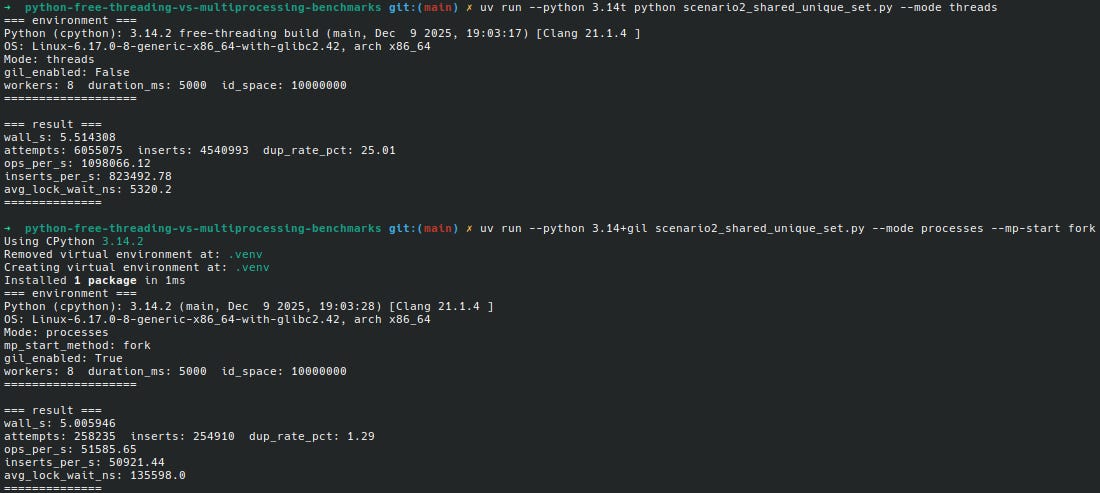
Results (Ubuntu 25.10 / Linux 6.17 / x86_64)
Threads (free‑threading, 8 workers):
1,098,066.12 ops/s (attempted check+insert)
823,492 inserts/s
avg lock wait: 5.32 µs
duplicates: 25.01% (because the set actually gets big)
Processes (8 workers): the start method basically doesn’t matter here.
Also notice the lock wait ratio: in processes mode the “wait to acquire the lock” is about 25.4× higher (≈135.5 µs vs 5.32 µs).
That’s not just contention — it’s “you made the critical section slow, so everyone queues longer”.
“But the duplicate rate is different!” — yep, and here’s why
Threads did ~4.5 million inserts into a 10 million ID space in 5.5 seconds (wall_s) — we’re at ~45% occupancy, so duplicates start showing up a lot.
Processes only managed ~250k inserts — ~2.5% occupancy — so of course the duplicate rate stays low.
So don’t compare duplicate rate across modes. Compare ops/s and lock wait, because those reflect the actual bottleneck.
What this teaches (and what it does not teach)
This does not say:
“processes are useless”
“threads always win”
“free-threading solved everything”
It says something narrower and more useful:
If you try to do multiprocessing and keep a single shared mutable data structure consistent with a lock + manager proxy,
you just built a distributed system with one tiny database… and then put it in your inner loop.
That’s why it collapses to ~50k ops/s.
Practical takeaways
If you’re in threads (free-threading build):
Shared structures and a lock can be totally fine… until the lock becomes the program.
avg_lock_wait_nsis your “are we turning into a single lane?” early warning signal.
If you’re in processes:
Avoid “shared dict/set with Manager + lock” for hot paths.
Prefer:
sharding (each worker owns a subset; merge later)
local sets + reduce (map/reduce style)
message passing (queues) instead of shared state
real shared memory only if you absolutely must (and you’re ready for pain)
Scenario 2 is the cautionary tale: multiprocessing gives parallel CPU, but a shared mutable state can delete it.
Bonus: The “Native Speed” Limit (Rust vs Python, same algorithm, threads)
To estimate how much overhead the Python runtime adds in Scenario 2, I rewrote the threads version in Rust scenario2_shared_unique_set.rs using the same SplitMix64 PRNG and the same algorithmic shape: generate ID → lock → check → insert.
This is not perfectly apples-to-apples (Rust stores u64 values directly; Python stores boxed int objects), but it gives a useful lower bound for “how fast can this pattern go if the runtime overhead is minimized”.
Ubuntu 25.10 / x86_64, 8 workers, duration=5s, id_space=10,000,000 (raw run output in python_vs_rust_runs.txt):
Note:
CPU Usagehere is/usr/bin/timepercent CPU — 390% means ~3.9 cores worth of CPU on average over the run.
Takeaway:
Throughput is surprisingly close (Rust is only ~1.33× faster). Why? Because contention is the great equalizer: a large fraction of work is waiting to acquire the same OS mutex.
Memory is where Python pays the rent: this run peaked at ~3.3× higher RSS (boxed
intobjects in asetvsu64in aHashSet).CPU usage: across the full run (warmup+measured), Python averaged 390% CPU vs Rust 238%. Python burns more CPU-seconds per op (interpreter + object overhead) and triggers significantly more context switching under contention.
Conclusion: for lock-heavy workloads like this, free-threading gets you into the same order of magnitude as native code. You aren’t losing 100× performance anymore; you’re paying a 30% tax for the convenience of Python.
Scenario 3: Sharded writers (multiprocessing without shared state)
Scenario 2 used a Manager().dict() and a shared lock, which turns every “check + insert” into IPC.
Scenario 3 replaces that with M writer processes, each owning a shard of the set, and routes items by hash so the same key always lands on the same writer.
If this sounds familiar, it’s because it’s effectively the Actor Model (think Erlang or Akka): workers hold private state and communicate purely via messages, removing the need for locks entirely.
Workload idea
M writer processes each hold a local
set.N producers generate IDs and send
(worker_id, uid)to a shard queue:shard = uid % writers.The writer does
uid in setand, if new,set.add(uid), then sends an ACK back to the producer.Each producer blocks on its ACK before sending the next ID, so insert/duplicate is explicit and counts are exact.
Each writer is still single‑threaded, but now different keys can be handled in parallel.
We’ve removed the manager proxy and the shared lock; the only shared cost is IPC + ACK per item.
How to run
uv run --python 3.14+gil scenario3_sharded_writer.py --writers N
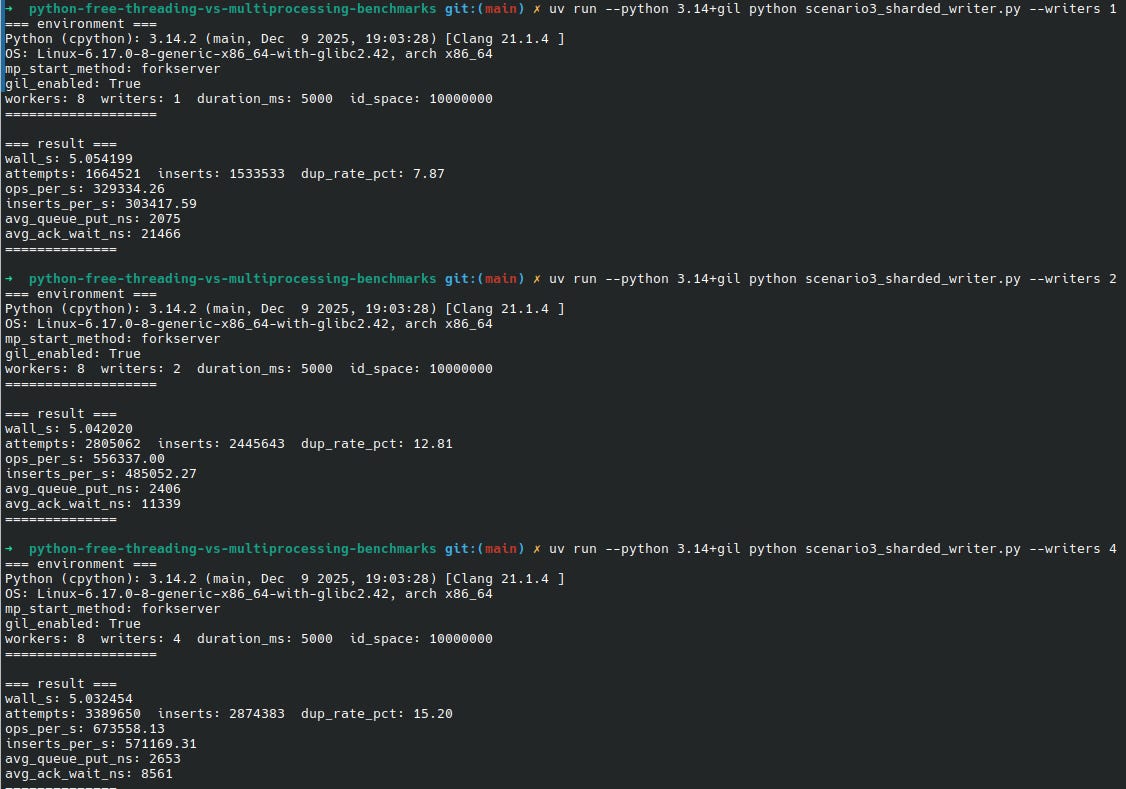
Results (Ubuntu 25.10 / Linux 6.17 / x86_64)
Compared to Scenario 2’s ~50k ops/s for manager+lock, even the 1‑writer baseline is ~6× faster.
Sharding scales it further, and the mean ACK wait drops as writers fan out, but the queue put cost stays flat. That tells you the ceiling is still IPC + scheduling, not the set itself.
Cross-platform sanity check (macOS + Windows 11)
I focused the deep dive on Linux, but I also ran the same workloads on the spawn‑default platforms (macOS/Windows). Linux is included below as a reference point.
Scenario 2 (shared set + lock, 8 workers, 5s)
avg lock wait is the mean per-op time spent waiting to acquire the lock.
For Linux, the processes row uses spawn for apples-to-apples. The start method doesn’t matter much here because the Manager proxy dominates the cost anyway.
Scenario 3 (sharded writers, 8 producers, 8 writers, 5s)
Scenario 3 is process-only and bottlenecked by IPC.
Final Thoughts
We started by asking if you should swap processes for free-threaded threads.
In these benchmarks, for fine-grained CPU work, the answer is often yes — and it can simplify the implementation.
Fine-grained tasks: threads avoid the “boot a fresh interpreter” tax of
spawn(the default reality on Windows, and common on macOS). Pools amortize startup, but tiny tasks can still die on dispatch + IPC/serialization — and if you keep respawning workers, startup dominates again.Shared state: the big cliff isn’t “processes are slow” — it’s that shared mutable state across processes usually means IPC + serialization. In Scenario 2,
Manager().dict()turns a tiny critical section into a client/server round-trip. In Scenario 3, sharding recovers throughput, but every op still pays an IPC + ACK tax.Choosing the tool: use processes when you need isolation (crash containment, separate heaps, differing native libraries) or when tasks are chunky enough that startup/IPC fades into the noise. Use free-threaded threads when you want low overhead and true shared memory, and you can keep lock contention under control.
Free-threading doesn’t eliminate hard concurrency problems — but it does turn a lot of “parallel CPU + shared memory” designs back into single-process engineering problems instead of multi-process coordination problems.